
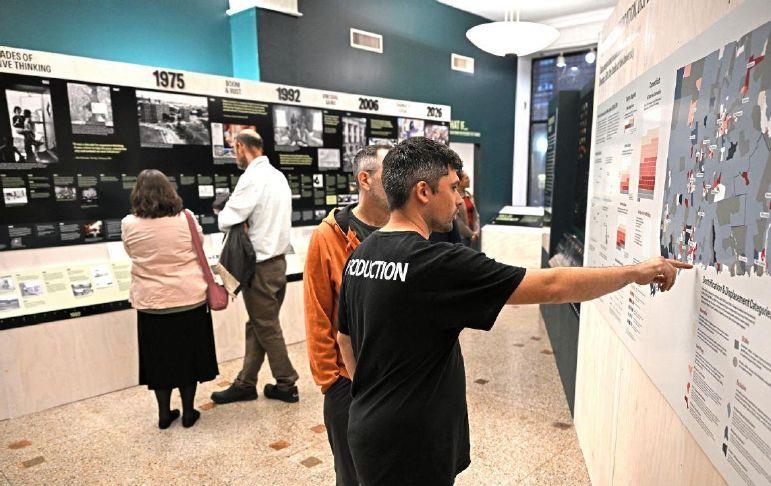
NEW LONDON — A free exhibition at the Garde Gallery is connecting the region’s housing pressures with the decisions, construction and community organizing that shaped where people live. “We Live Here/New London” remains open through December 18, with a related program on urban renewal scheduled for October 22.
Connecticut College and the Center for Housing Opportunity Eastern Connecticut developed the exhibition as part of a three-year research and public-dialogue project. The college says more than 50 students contributed. Historical photographs, residents’ recorded experiences, maps and architectural studies place local housing changes within a national timeline.
The exhibition opened with a September 24 reception; regular exhibition dates begin September 25. It is an ongoing project, rather than a newly announced housing development. The college identifies Anna Vallye and the center’s Beth Sabilia as directors of the Mellon Foundation-funded initiative, “A Right to Housing: Case Study Connecticut.”
The Day’s John Ruddy describes the exhibition’s connections between defense employment and housing demand: World War I-era construction in New London and the later Fort Hill Homes development in Groton are among its examples. His report also traces public housing, reused buildings and tenant organizing. That history offers context for current questions about affordability without treating every historical response as a solution for today.
The college says the displays include proposals developed by Yale architecture graduate students. Those designs explore possible ways to live in the New London area; they are educational concepts, not approved construction plans. Resident portraits and interviews bring individual experiences into the same conversation as buildings and policy.
A related free program, “Housing + Displacement: Mapping Lost New London,” is scheduled for Thursday, October 22, from 5:15 to 7 p.m. at the Visualization Wall in Connecticut College’s Shain Library, 270 Mohegan Avenue Parkway. This is a different venue from the downtown exhibition.
The organizer says that program launches an expanded digital account of New London’s 1941–1975 urban-renewal era, including historical photographs, residents’ recollections and an interactive map. It describes 104 downtown acres cleared and redeveloped under the Winthrop project, with contributions from Bill Morse, author of Lost New London.
The exhibition itself is at 305 State Street. The organizer lists free admission, Tuesday–Friday hours of 3–7 p.m. and Saturday hours of noon–4 p.m.; it will be closed November 24–28. Readers can check welivehere.site for current visiting information and program changes. No cancellation notice appeared on the exhibition homepage or the October 22 listing reviewed for this report.