
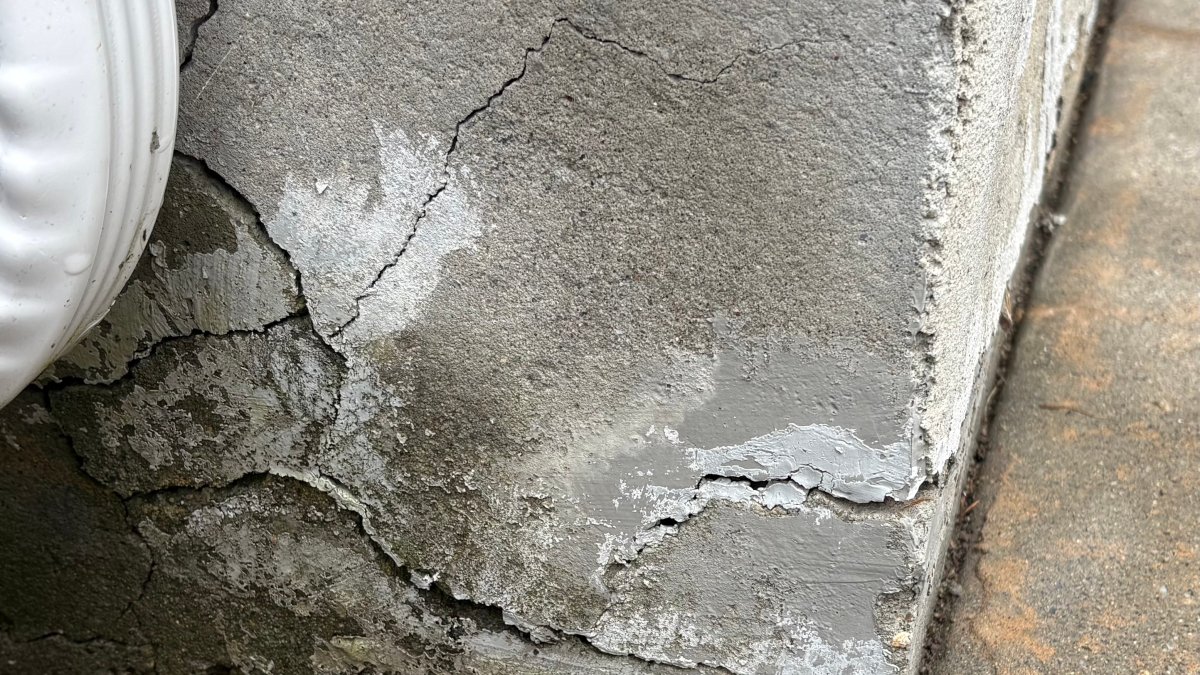
CONNECTICUT — Homeowners seeking help for crumbling concrete foundations face different deadlines depending on whether they need a replacement or are seeking reimbursement for work already completed. The distinction matters as renewed attention turns to the assistance program’s planned 2030 endpoint.
NBC Connecticut’s Len Besthoff reported October 16 that Gov. Ned Lamont visited Abbott Place in Ellington to review damaged and replaced foundations. The station reported a final $100 million infusion for the program and questioned whether available assistance would cover everyone still needing help. Eastern CT News has not independently reviewed the underlying funding authorization or a current uncommitted balance; that funding description is attributed to NBC.
The current Connecticut Foundation Solutions Indemnity Company guidelines, marked effective September 15, 2026, make the application deadlines more specific than a single sunset date. A Type 1 claim seeks assistance to replace a compromised foundation. CFSIC says it will stop accepting new Type 1 applications at 5 p.m. June 30,2030.
A Type 2 claim seeks reimbursement when an owner has already paid to replace all or part of a qualifying foundation. For those claims, CFSIC says both receipt of the application and active-claim status must be achieved before 5 p.m. March 15, 2027. Merely submitting an incomplete application by that date does not satisfy both conditions.
That earlier reimbursement deadline should not be confused with the 2030 Type 1 cutoff. Willington’s municipal website is encouraging potentially affected residents to learn about the program and links a town-specific resource guide. Homeowners should consult CFSIC’s current claim-type rules rather than rely on a general 2030 reminder alone.
The program’s current guidelines also differ from the round $200,000 assistance figure in NBC’s report. For new proposals first dated and submitted on or after January 20, 2026, the guidelines state a total cap of $205,000, including any partial reimbursement. Condominium claims have different per-eligible-unit limits. These are ceilings subject to allowable costs and eligibility, not automatic awards.
CFSIC explains that pyrrhotite in concrete can oxidize in the presence of water and oxygen, causing expansion and deterioration. Its rules caution that the mineral’s presence alone does not necessarily establish damaging deterioration. A qualified inspection and the required supporting evidence determine the applicable claim and severity classification.
The guidelines require evidence addressing construction date, ownership, foundation condition and relevant insurance claims, with additional requirements depending on the claim type and property history. A Type 2 reimbursement claim also requires documentation of completed replacement work and costs. The program’s October 12 update emphasizes the role of the visual examination and mandatory annual certification for participating inspectors and engineers.
Assistance is constrained by eligibility, damage severity, payment caps and available funding. CFSIC explicitly warns that it cannot cover every eligible cost or necessarily pay every claim that might arise, and that insufficient resources could halt new application activity before the stated endpoint. Filing is not a promise of payment or a construction timetable.
Residents can start with CFSIC’s application instructions and current guidelines. The program identifies ESIS ProClaim as its claims administrator and lists 844-763-1207 for questions. Homeowners should have their claim type, required evidence and active status confirmed by the administrator; no individual property’s eligibility is determined by this report.