
CONNECTICUT — Two bat species found in Connecticut also turned up in a New Jersey study of an invasive insect: researchers detected spotted lanternfly DNA in droppings from big brown bats and an eastern red bat.
The paper, published February 28, 2025, in the journal Forests, examined 330 guano samples from five bat species collected at three New Jersey sites during 2018, 2019, 2021 and 2022. This is earlier research, not a newly completed Connecticut field study.
Researchers detected lanternfly DNA in 33 of 303 big brown bat samples and one of 17 eastern red bat samples. Samples from three other species did not test positive, but their numbers were too small to establish that those bats never eat lanternflies.
The authors interpret the DNA evidence as support for lanternfly consumption and propose testing guano as a way to supplement invasive-pest surveillance. Detecting DNA in a dropping does not count the number of insects eaten or show that bats reduce lanternfly populations enough to control an infestation.
The Connecticut Department of Energy and Environmental Protection identifies both big brown and eastern red bats among the state’s bats. Its wildlife information, updated in May 2026, describes big brown bats as cave-hibernating bats and eastern red bats as one of Connecticut’s tree-roosting species. That establishes local species relevance; it does not turn the New Jersey results into measurements of Connecticut feeding behavior.
The study also notes limited samples for less-common species and calls for further research. Its practical contribution is evidence that bat diets can reveal the presence of an invasive insect, alongside conventional monitoring methods.
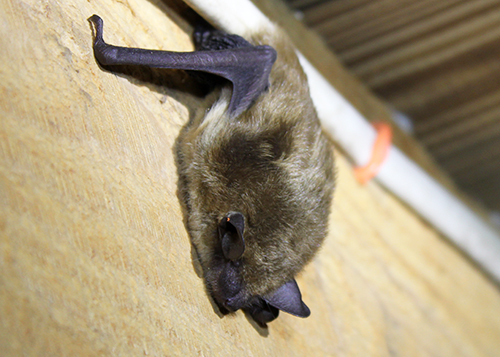
This AI-prepared report draws on the original research paper and Connecticut DEEP’s public species information. The accompanying DEEP photograph is a file image of a big brown bat, not a photograph of a bat sampled in the study.